 Glyphfield
Create
Use $glyphfield-create to build and revise editable Design Lab compositions without losing source structure.
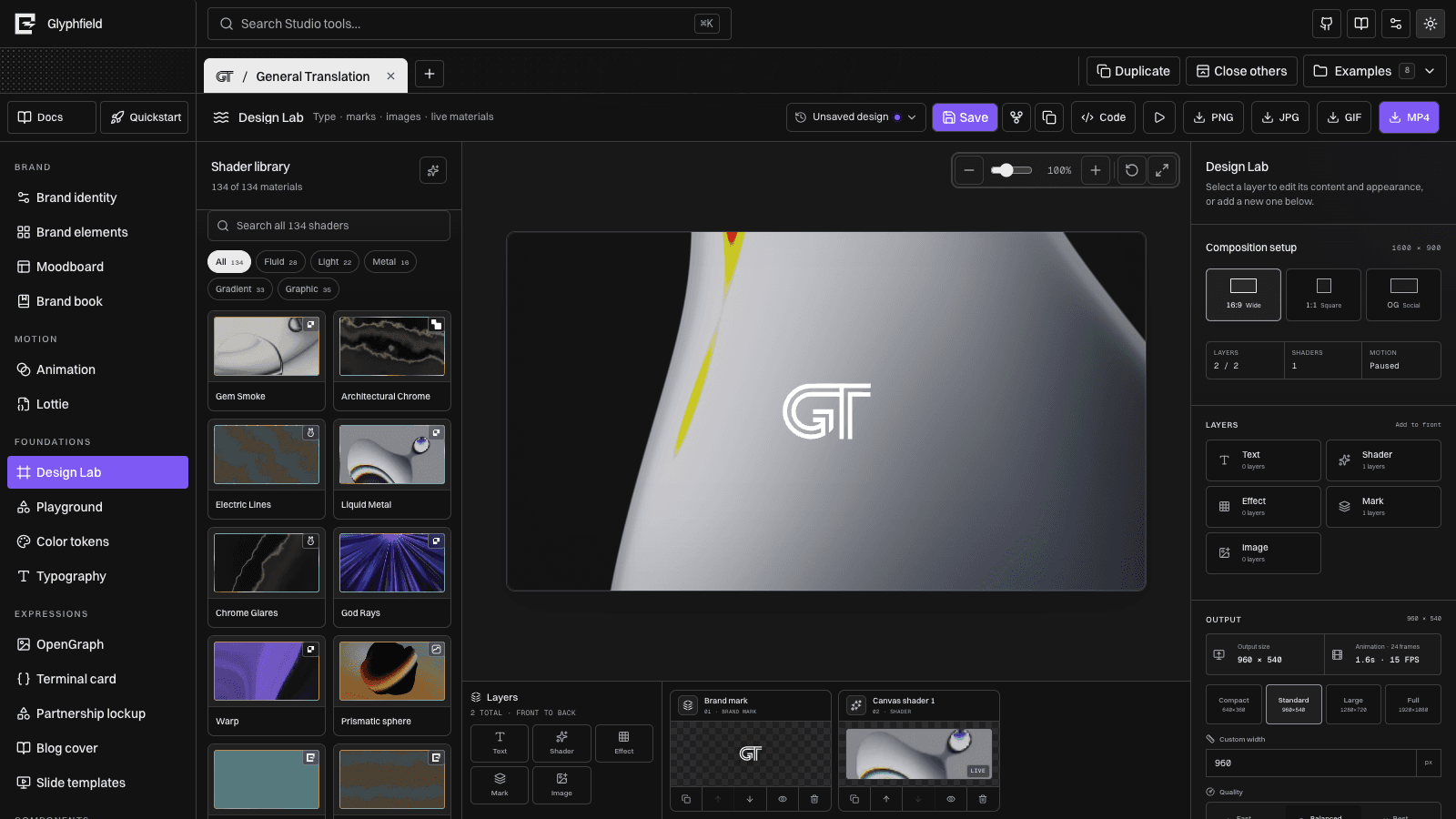
$glyphfield-create owns editable visual composition. Use it for Design Lab artboards containing text, marks, images, stickers, shader layers, converter effects, and saved designs.
Invoke it
Ask for the skill explicitly or describe a matching outcome:
Use $glyphfield-create to build a 1920×1080 launch card with Gem Smoke,
two editable text layers, the active brand mark, and a subtle Bayer overlay.
Save the composition as “Launch signal”.
Workflow
- Identify the active brand, dimensions, still or motion intent, and whether the work starts from an existing design.
- Open Design Lab and call
describe()before relying on controls or actions. Its public tool ID ismaterial. - For existing work, call
readSource()and preserve unknown fields, stable page and element IDs, asset records, and back-to-front ordering. - Add or update only the necessary layers. Use each layer's own opacity, blend mode, geometry, and effect settings.
- Apply the complete source through the Studio adapter, then re-read the normalized CanvasDocument.
- Inspect the authentic canvas at the intended shader frame and save the design when it needs to be restored later.
Composition rules
- Start with no shader when the brand mark is strong enough; otherwise Gem Smoke is the preferred general-purpose material.
- Keep shader layers behind authored content unless the composition intentionally masks or converts the result.
- Give Bayer, ASCII, halftone, and posterize effects deliberate foreground and background colors.
- Preserve contrast between white artwork and white sticker borders with a fill, outline, alpha-aware shadow, surface, or border color.
- Treat shader size as material zoom from
0.1to10, not as canvas zoom. - Save the selected frame history and timeline state with the design.
Completion proof
The skill is not finished when source application resolves. Confirm layer order, visible placement, identity, opacity, selected material frame, saved-design restoration, and the resulting canvas. If the request includes a file, hand the result to $glyphfield-export.