 Glyphfield
Documentation
Define one brand system, compose production artifacts, animate it, and let agents operate the same tools.
Glyphfield is a local-first, open-source brand studio. It keeps identity foundations, design applications, live materials, motion, source documents, exports, and agent operations connected instead of treating each output as a separate file.
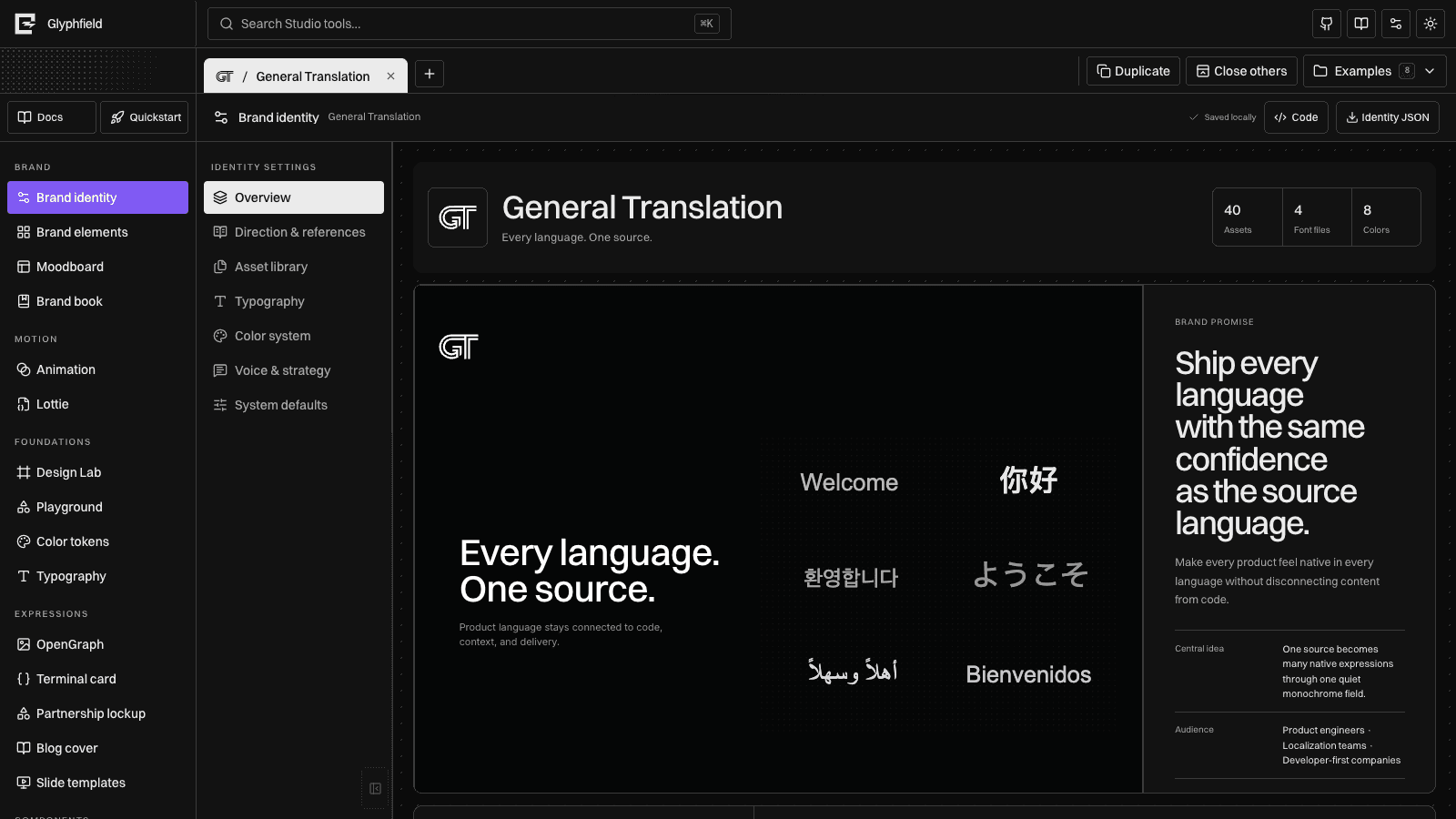
Choose a path
What is connected
Strategy, art direction, logos, authorized assets, colors, typography, language, voice, applications, and defaults.
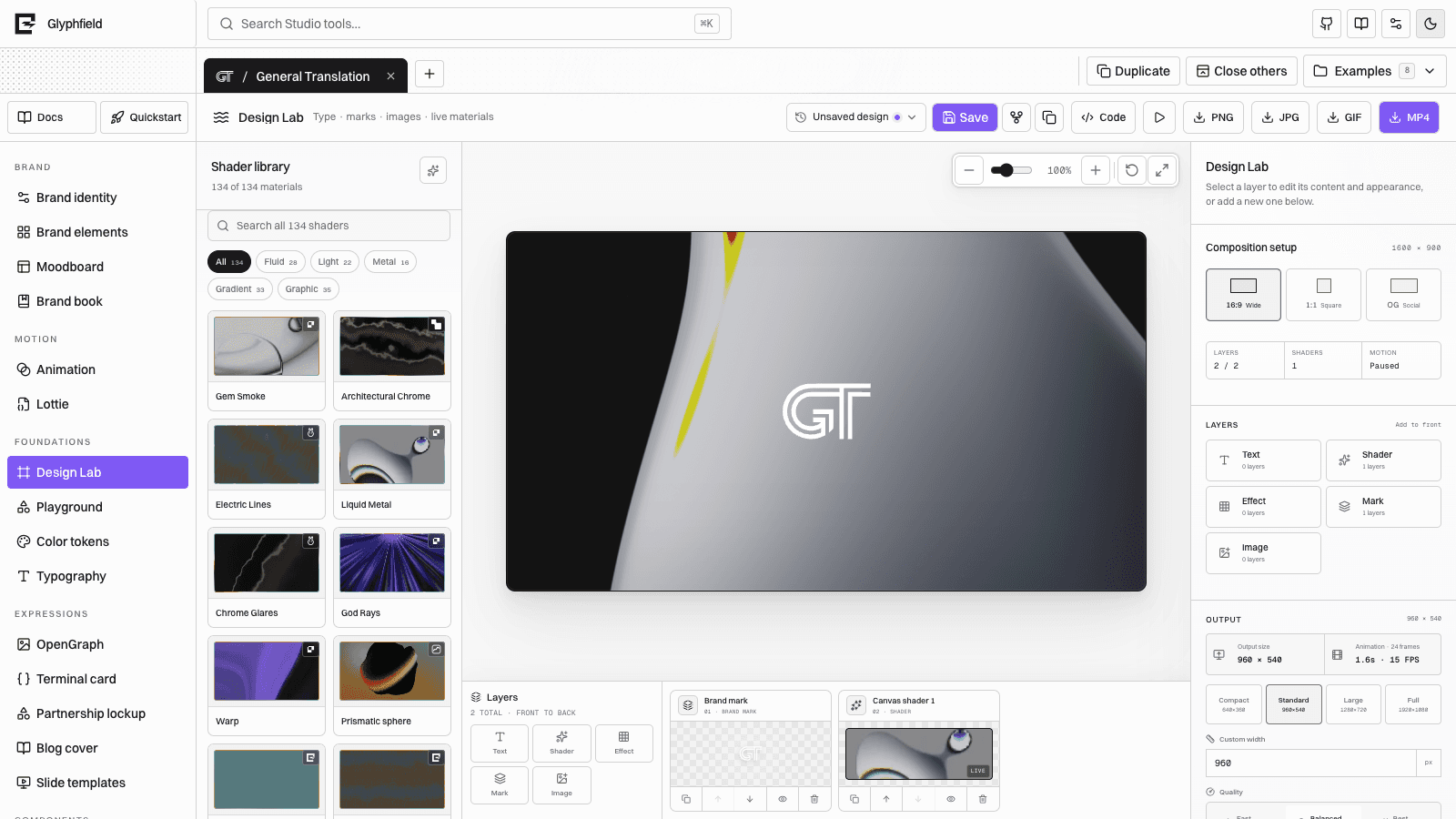
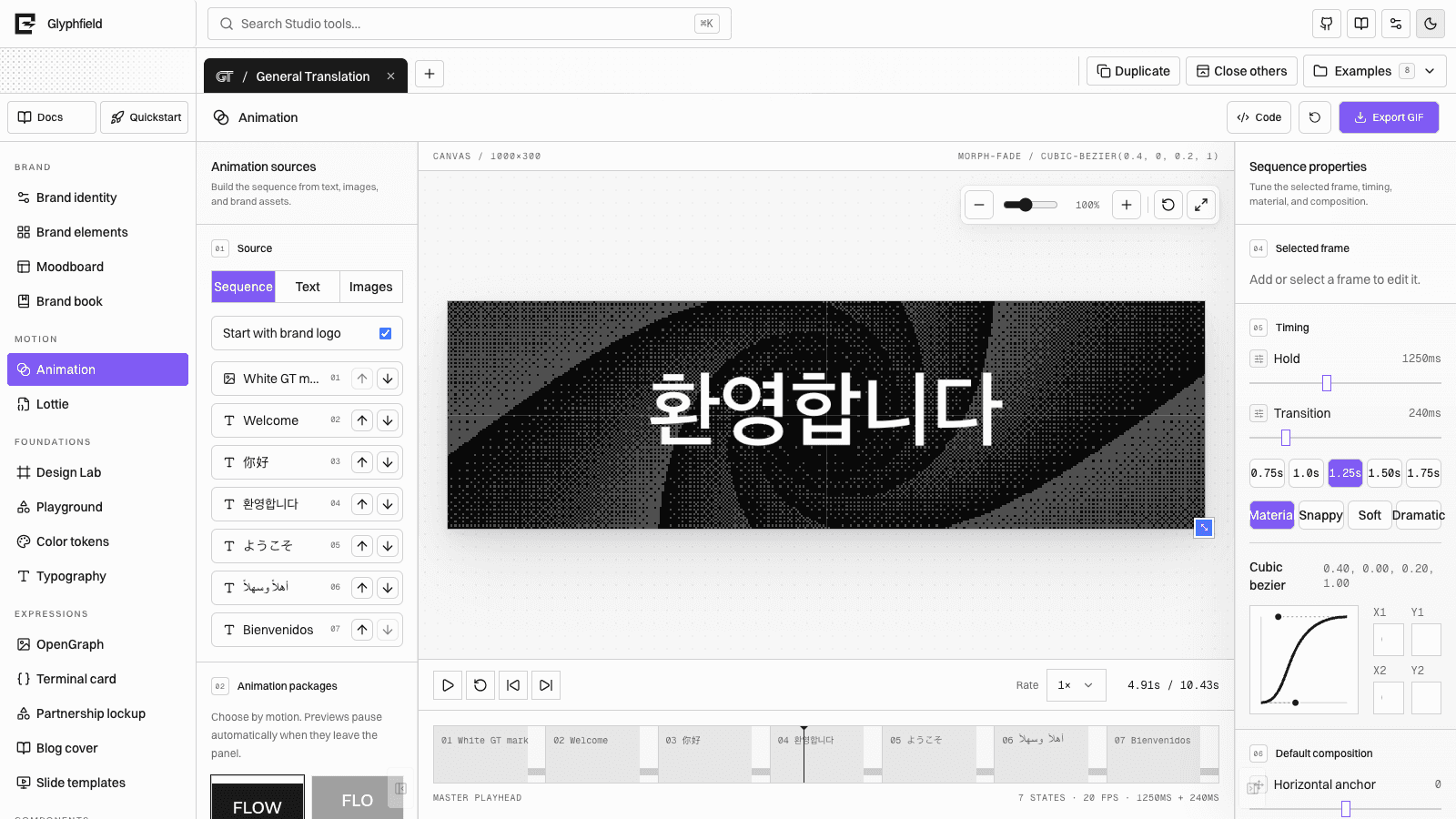
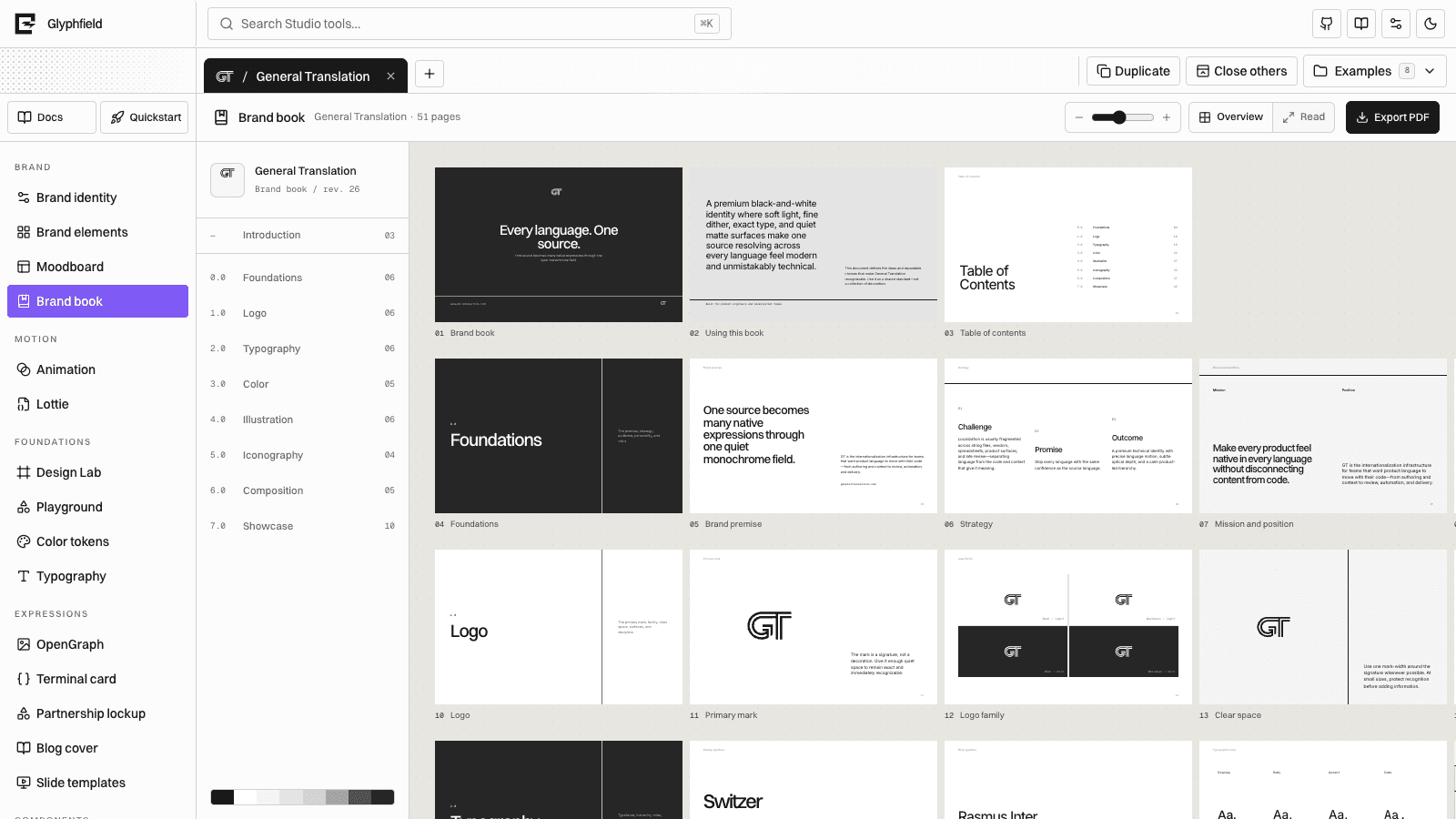
Brand elements, moodboards, a complete brand book, Design Lab, Animation, Lottie, templates, tokens, type, and components.
Exact source drawers, a versioned canvas scene graph, saved designs, autosave recovery, layer history, and export preflight.
Versioned discovery, deterministic HTTP generation, processed markdown, full-text docs, and browser-native automation.
See the system
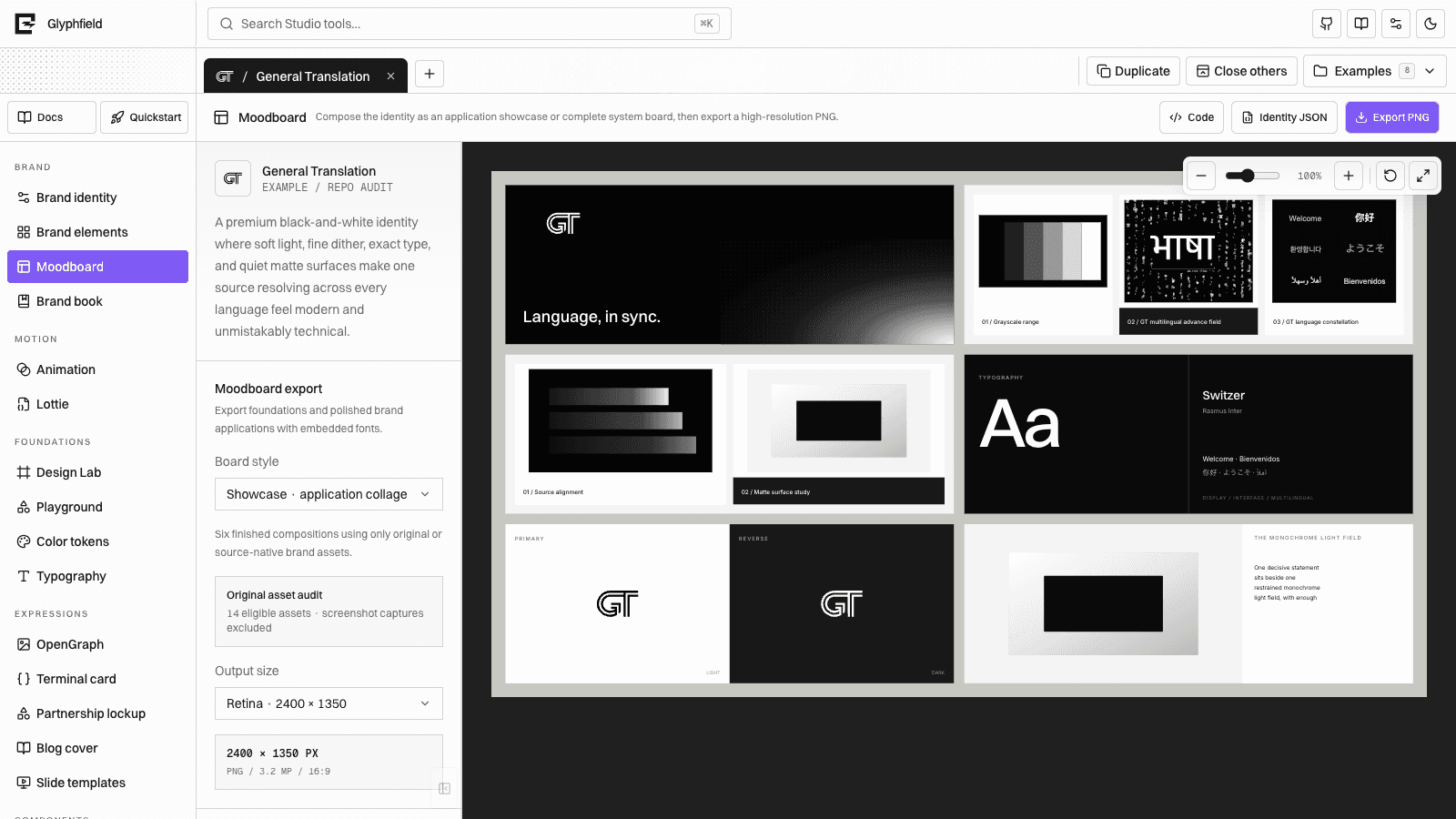
Human and agent parity
The visual UI and agent surfaces share the same owners:
/api/agent,/api/catalog,/api/labs,/api/materials,/api/identities, and/api/elementspublish current capabilities.POST /api/generatevalidates deterministic template, background, element-brief, and Design Lab sequence requests.window.glyphfield.studiooperates the active browser tool, including local files, exact source, Canvas, WebGL, GIF, and MP4.- Every documentation page is available as processed markdown by adding
.mdto its URL. /llms.txtis the compact agent router;/llms-full.txtis the complete generated documentation corpus.
Agents should discover first, choose an interface deliberately, apply the smallest source change, visually verify browser-rendered work, and treat a non-empty returned or downloaded artifact as completion.
Local-first by default
Browser projects, saved designs, uploaded files, fonts, and drafts remain in the current browser profile. Stateless generation requests are processed in memory and do not silently read or mutate a browser-local project. Remote asset URLs are intentionally unsupported.
Operate and extend
Keep identity and tool source, original authorized assets, and rendered proofs outside the browser.
Separate source, storage, Canvas, WebGL, codec, and download failures without clearing the active project.
Serve the dynamic docs, discovery, generation, OpenGraph, and Studio routes with browser capabilities intact.
Update catalog, state, source, Browser API, HTTP, docs, exports, and tests as one parity chain.
- Back up and restore a project
- Troubleshoot Studio and exports
- Check browser capabilities
- Self-host Glyphfield
- Review version compatibility
- Contribute to Glyphfield
Important links
- Open the Studio
- Read the compact agent runbook
- Read the complete agent corpus
- Inspect the agent manifest
- Inspect OpenAPI 3.1
- Read the contribution guide
- View the source
Glyphfield software is released under the MIT License. Bundled third-party marks, fonts, textures, shaders, and reference-brand assets retain their own licenses and ownership.