 Glyphfield
Troubleshooting and recovery
Diagnose Studio loading, storage, source, WebGL, asset, GIF, MP4, and export failures without losing the active design.
Preserve the editable source before changing the environment. Most failures are easier to reproduce than to reconstruct after browser storage or local inputs have been cleared.
First response
- Stop playback or any active export.
- Copy the current source from Code or
readSource(). - Record the active identity, public tool ID, output settings, and exact error.
- Keep the original local files available.
- Retry only after changing the actual failure condition.
Do not clear site data, delete a project, or rebuild the document from an example as a first troubleshooting step.
Symptom guide
| Symptom | Likely boundary | Safe next action |
|---|---|---|
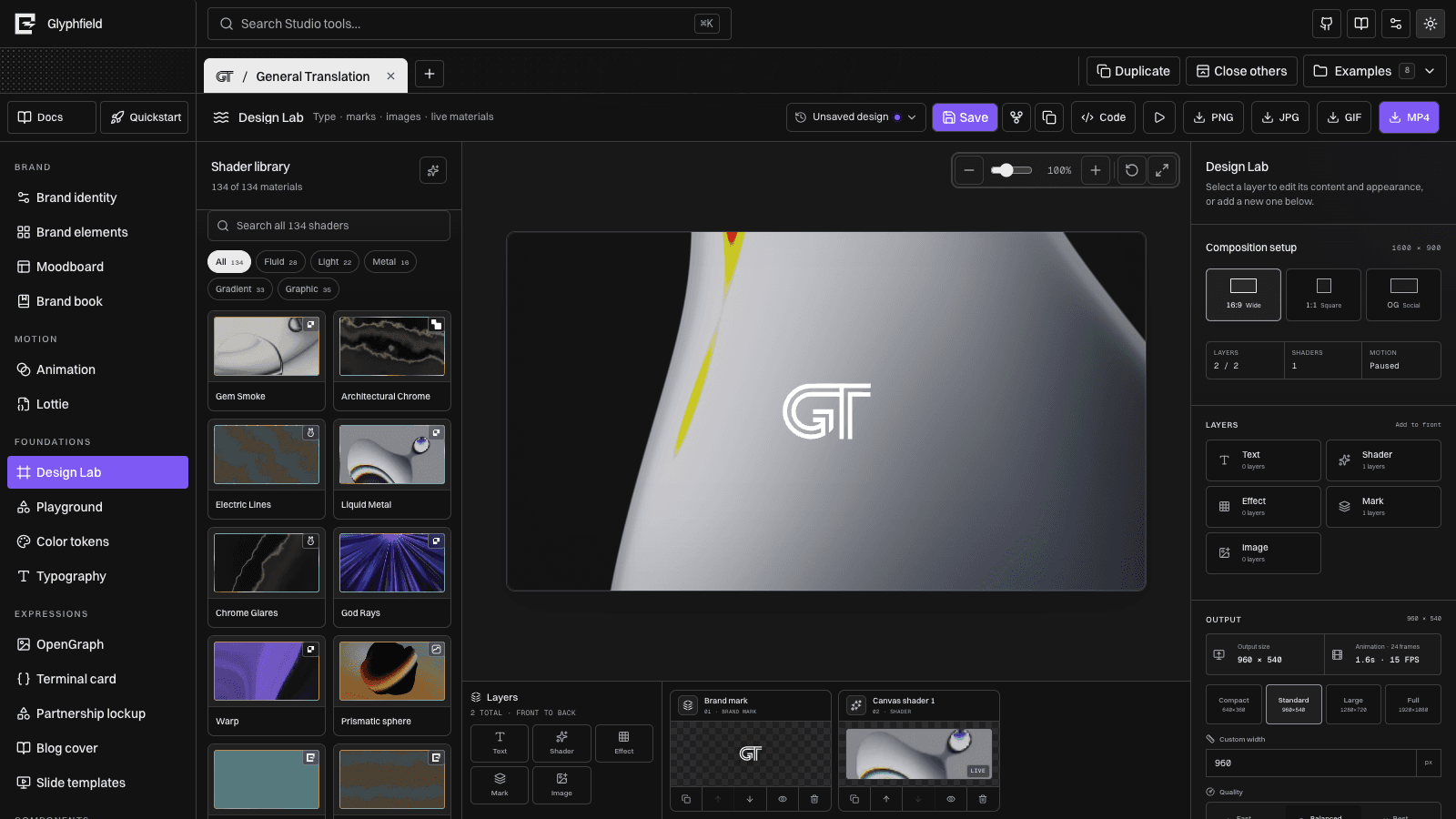
| Shader card or canvas is blank/static | WebGL/WebGL2 unavailable, lost context, offscreen preview budget, or reduced motion | Bring the preview onscreen, stop duplicate live canvases, reload once, and test another material; do not claim motion from a static fallback |
| Canvas looks clipped or too small | View zoom/pan differs from output geometry | Use Fit/Reset and verify declared output dimensions; changing zoom must not change export size |
| Logo, text, or layers shift after restore | Stale/reconstructed source, changed IDs, missing assets/fonts, or wrong tool | Reapply the exact current document, preserve IDs/order, restore dependencies, and re-read after apply |
| Save state remains “preparing” or reports error | IndexedDB blocked, storage quota/transaction failure, or page closing during write | Copy Code source immediately, remain on the same origin, and retry in a persistent browser profile |
| Local image/font disappears after reload | Session object URL or original bytes were not embedded | Reattach the authorized original file and export a new portable source/proof |
| PNG/JPG is empty | Canvas context or encoder returned no bytes | Reduce dimensions for diagnosis, reload the renderer, and require a non-empty Blob before completion |
| GIF has a flashing text/color frame | Source color changes between frames or palette quantization cannot hold the intended colors | Compare still captures at the same times, confirm source colors are stable, use a solid background where appropriate, then retry at a lower diagnostic size |
| GIF repeats with a visible jump | Repeat flag is set but visual endpoints differ | Choose Seamless, inspect the seam report and actual wrap, or use Raw only for periodic/intentionally cut motion |
| MP4 fails before rendering | Browser exposes no compatible MP4 video codec | Preserve source and use another supported environment; do not silently substitute GIF |
| MP4 plays but required audio is absent | Audio decode/mix/codec failed or the tool has no audio source | Verify the Animation audio track and inspect the final file; GIF never contains audio |
| Export stalls or browser memory spikes | Too many concurrent jobs or excessive pixels × frames | Stop other previews, run one export, test smaller width/FPS/duration, then return to the required settings |
applySource() throws | JSON/schema/field validation, wrong active tool, or stale adapter | Re-read describe() and readSource(), change only the intended field, and wait for the tool-ready event after navigation |
| Docs/sidebar behaves incorrectly at a narrow width | Stale CSS/client state or an unsupported embedded webview | Hard reload, test the same route in a current full browser, and include viewport dimensions in the report |
Recover a Design Lab draft
Design Lab autosaves the complete portable document to IndexedDB and uses a small localStorage recovery journal while a newer write settles.
- Return to the exact origin and browser profile where the design was edited.
- Reload once without clearing data.
- Select the original identity and Design Lab.
- Wait for autosave restoration to finish.
- Open Code and copy the restored document.
- Create a named save and export a proof after visual inspection.
If the design does not return, check whether the hostname, scheme, port, browser profile, or private-browsing state changed. Browser storage does not follow those changes automatically.
Diagnose source application
const studio = window.glyphfield.studio;

console.log({
  tool: studio.activeTool(),
  description: studio.describe(),
  controls: studio.controls(),
});

const before = studio.readSource();

try {
  const document = JSON.parse(before);
  // Make one targeted change while preserving the envelope and stable IDs.
  await studio.applySource(document);
  const after = studio.readSource();
  if (!after) throw new Error('The applied source could not be read back.');
} catch (error) {
  console.error(error);
  // Retain `before`; do not write directly to browser storage.
}
After changing tools, wait for glyphfield:studio-api-ready and re-read window.glyphfield.studio. A stale adapter can expose actions from the previous tool.
Diagnose still export
For PNG/JPG:
- Export at a modest width such as 960 pixels.
- Confirm the returned Blob is non-empty.
- Confirm MIME type and extension agree.
- Decode the file and verify its pixel dimensions.
- Check transparency for PNG and the selected opaque background for JPG.
- Compare the result to the preview at Fit or 100% inspection zoom.
If the small proof succeeds and the target size fails, the issue is likely resource pressure rather than invalid source.
Diagnose GIF
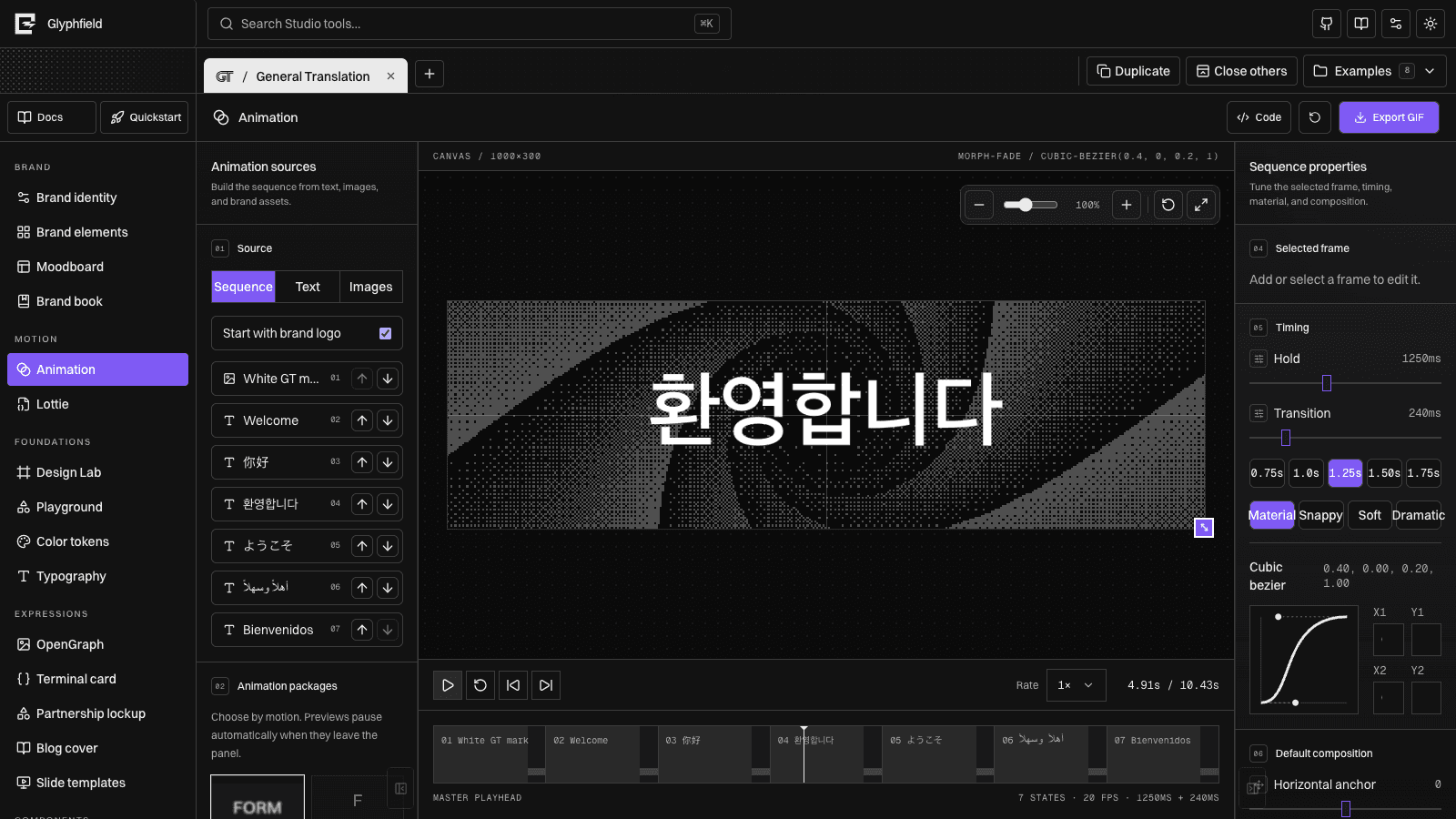
- Inspect more than the first frame; a valid GIF can still contain no visible motion.
- Compare text/logo colors at multiple frames to distinguish source flicker from palette quantization.
- Keep important foreground colors explicit. Glyphfield protects known brand/text colors, but a highly complex moving palette can still require a smaller proof or simpler composition.
- Use Seamless only when closure is required and inspect the final-to-first transition.
- Remember that GIF has no audio channel.
Diagnose MP4
MP4 encoding asks the browser for an encodable video codec and fails before starting if none is available. Animation adds an audio track only when a decoded audio buffer and supported audio codec are available.
Try one change at a time:
- One export job only.
- Lower diagnostic width.
- Lower diagnostic FPS or duration.
- No audio, to isolate video encoding.
- A current full desktop browser with hardware acceleration.
Restore the requested dimensions/audio after identifying the failure. A lower-resolution proof is not the final deliverable unless the user accepts it.
Useful diagnostics
Capture this information without including confidential assets:
- Glyphfield URL and deployed commit/version if known.
- Browser and operating system.
- Viewport size and device-pixel ratio.
- Active identity and public tool ID.
- Source schema versions, not necessarily the full source.
- Material ID, output format, dimensions, duration, FPS, quality, and loop mode.
- Whether Canvas 2D, WebGL/WebGL2, IndexedDB, localStorage, and downloads work.
- Exact error message and whether a non-empty Blob was returned.
- A screenshot or short recording showing the failure.
For API errors, include HTTP status, structured error.code, error.field, and request kind; redact embedded assets.
See Browser support, Backup and restore, Errors and limits, and Version compatibility.
API security
Operate Glyphfield's public generation API with bounded inputs, no remote fetching, explicit CORS, rate limiting, and deployment verification.
Accessibility
Use and extend Glyphfield with keyboard access, visible focus, semantic controls, reduced motion, contrast, and accessible exported artifacts.