 Glyphfield
Agent integration
Give LLMs and coding agents structured discovery, deterministic generation, and a browser fallback for visual capabilities.
Glyphfield exposes a public, versioned agent interface. An agent can discover the product without scraping application JavaScript, generate portable assets or apply-ready compositions over HTTP, and operate every visual Studio control through the programmatic Browser API.
Discovery surface
| Resource | Purpose |
|---|---|
/llms.txt | Canonical operational runbook for language models |
/llms-full.txt | Complete concatenated documentation corpus generated from current MDX |
/api/docs/{slug} | One processed documentation page as Markdown |
/api/agent | Versioned manifest, policies, resources, and generation contract |
/openapi.json | OpenAPI 3.1 route document |
/api/catalog | Studio tools and capability keywords |
/api/labs | Every Studio lab plugin and its shared-library capabilities |
/api/materials | Every shader, attribution, palette, look preset, and editable control |
/api/identities | Built-in template and reference identity records |
/api/elements | Searchable brand application records |
/api/generate | GET contract and POST generation endpoint |
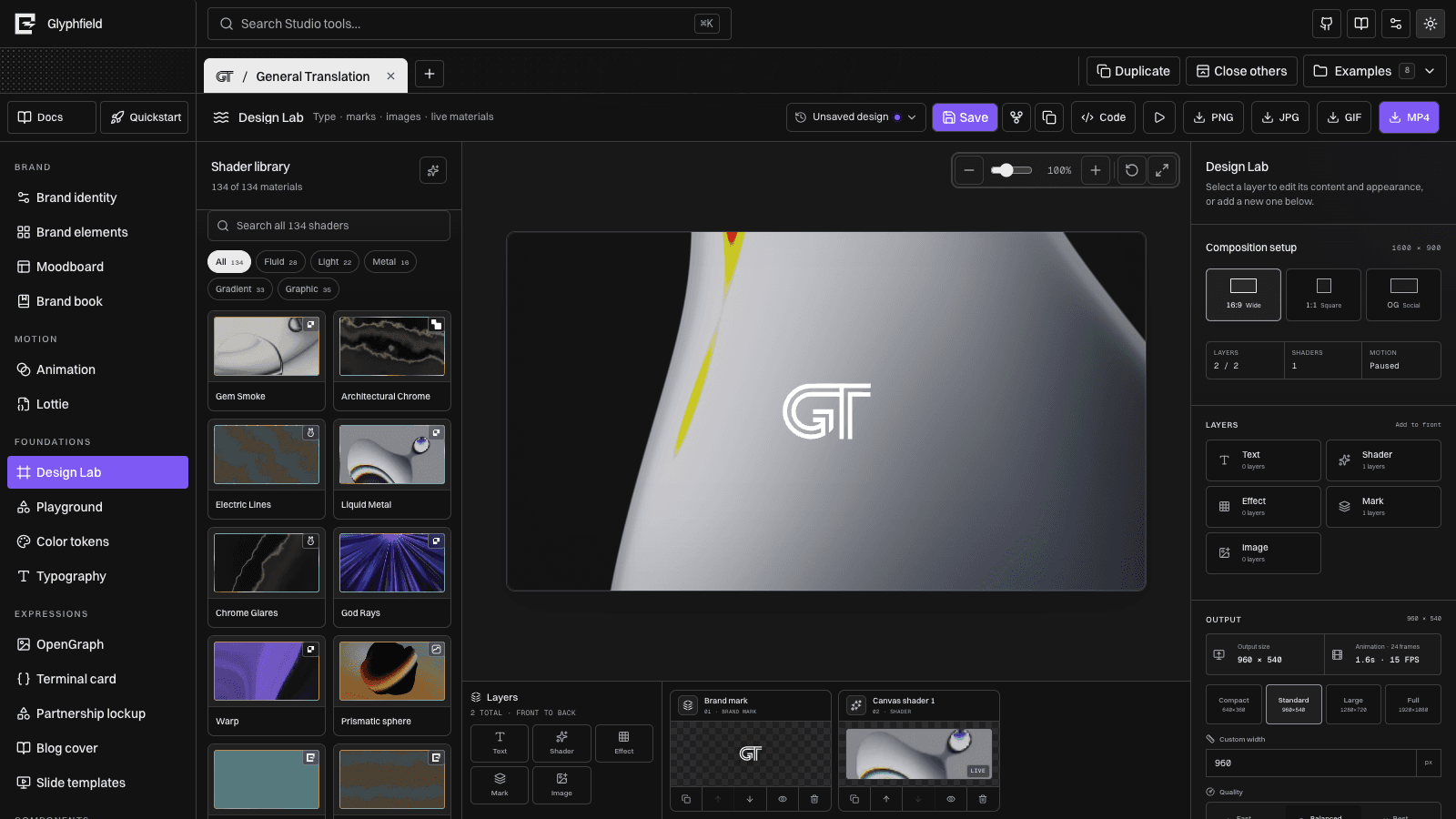
/studio | Browser-local visual workspace |
skills/ | Installable task skills for creation, HTTP generation, Studio operation, and export verification |
Three connected surfaces
HTTP generation
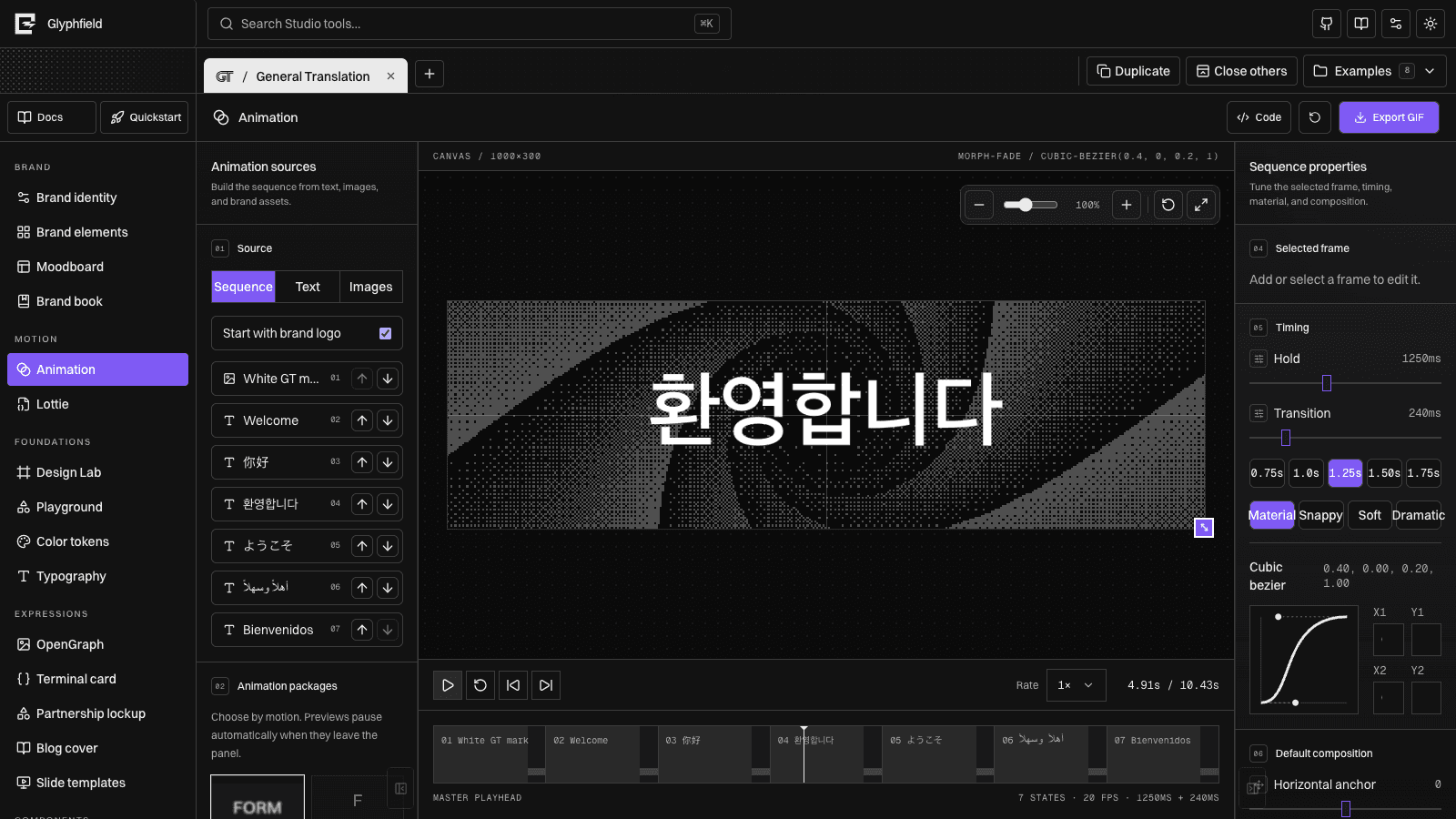
Use HTTP when the desired artifact is a template SVG, background SVG, element brief, or an apply-ready Design Lab sequence document. This path is deterministic, portable, and does not require a browser until a requested result depends on live rendering.
Browser operation
Use the Studio when a task requires Canvas, WebGL, local fonts, local images, visual placement, high-resolution PNG/JPG rasterization, GIF or MP4 capture, Lottie, or exact source edits to an active browser artifact. Browser-capable agents use window.glyphfield.studio to apply validated source, inspect the resulting canvas, operate accessible controls, and export the real composition.
Documentation corpus
Use /llms.txt to route the task, /llms-full.txt to load the full current product model, and /api/docs/{slug} when only one topic is needed. These routes are built from the same documentation source as the human UI.
An agent should use the smallest interface that fully expresses the requested artifact. HTTP and browser operation are deliberately composable rather than mutually exclusive.
Operating invariant
Agents must discover, mutate, and verify:
- Discover the live contract and catalog IDs.
- Read current source before changing an open artifact.
- Preserve unknown fields and apply the smallest change through a validator.
- Re-read state after applying it.
- Inspect visual output when appearance matters.
- Confirm the actual file or Blob, not only the request status.
No API key
The current public agent routes do not require authentication. Do not invent an Authorization header. Always re-read /api/agent and GET /api/generate because availability and schemas may change.
Install or inspect the focused Glyphfield Skills, then start with Choose an interface, Connect an agent, and the complete Agent recipes.